lunes, 22 de diciembre de 2014

22 de Diciembre de 2014, posteando fotografías de un viaje anterior, en esta ocasión a Tarragona, España.

Tarragona es la Tarraco romana, que primero fue capital de la Hispania Citerior, tras derrotar a los cartagineses y posteriormente de la provincia Tarraconensis de Hispania, tras dividir la península en tres provincias: Lusitania, Bética y Tarraconensis, con capitales respectivas en Emerita Augusta (Mérida), Hispalis (Sevilla) y Tarraco (Tarragona). Tarraco, finalmente fue obra de los Escipiones, su creación durante las guerras púnicas, como Cartago Nova lo fue de los cartagineses. Tarraco estaba organizada como "conventus civium Romanorum", convento, convención, reunión de los ciudadanos romanos de la provincia. Tarragona, durante la Edad Media, aparece como un municipio plenamente consolidado hacia mediados del siglo XII. Durante el reinado de Juan II de Aragón la ciudad se alineó con la Generalidad catalana en la guerra civil mientras que el Rey gozó del apoyo del arzobispo de Barcelona. Esta guerra fue nefasta para la ciudad. A partir de 1811 los franceses ocupan la ciudad durante la Guerra de la Independencia, Guerra Peninsular o Guerra del Francés. Hasta 1813 no abandonaron la ciudad, dejándola en la ruina. Tarragona sufrió nuevamente durante la Guerra Civil Española 1936-1936, pues fue bombardeada numerosas veces. El puerto siempre ha sido muy importante, y se encuentra entre los 5 mayores de España para barcos de gran tonelaje. La industria del petróleo y petroquímica forma parte del paisaje local. En la actualidad se trata de una ciudad moderna y pujante, y su visita es obligada para los que gustan de los restos romanos.

Tarragona is the Roman Tarraco, which was the first capital of the Nearer Spain, after defeating the Carthaginians and later the province of Hispania Tarraconensis, after splitting the peninsula into three provinces: Lusitania, Andalusia and Tarraconensis, with capitals in Emerita Augusta (Mérida), Hispalis (Seville) and Tarraco (Tarragona). Tarraco finally was the work of Scipio, its creation during the Punic Wars, as it was Carthage for Carthaginians. Tarraco was organized as "conventus civium Romanorum", convent, convention, meeting of Roman citizens in the province. Tarragona, during the Middle Ages, appears as a municipality fully consolidated by the mid-twelfth century. During the reign of John II of Aragon the city sided with the Catalan Generalitat in the civil war while King enjoyed the support of the Archbishop of Barcelona. This war was disastrous for the city. From 1811 the French occupied the city during the War of Independence, Peninsular War or French War. Until 1813 they did not leave the city, leaving it in ruins. Tarragona suffered again during the Spanish Civil War 1936-1936, it was bombed several times. The port has always been important, and it is among the top 5 in Spain for large-tonnage ships. The oil and petrochemical industry is part of the local landscape. Today it is a modern, thriving city, and its visit is a must for lovers of Roman remains.


domingo, 21 de diciembre de 2014

21 de Diciembre de 2014, posteando fotografías de un viaje anterior a Burgos, España.

Burgos es la histórica ciudad de Castilla que fue fundada por el Conde Diego Rodríguez el año 884, y hacia 930 se convierte en sede del Condado de Castilla. Los sucesores del Conde Fernán González mantienen en herencia el condado, y en 1.065 se convierte en Reino al ser dividida la herencia de Fernando I de León, que cede el Condado a título de Reino a su hijo Sancho II el Fuerte. Aunque Sancho consiguió reunificar la herencia de su padre, fue finalmente Alfonso VI, su hermano, el continuador de la dinastía con los Reinos de León y de Castilla unificados. Burgos fue la capital de los reinos unificados intermitentemente hasta los Reyes Católicos. En 1.512, Fernando V de Castilla y II de Aragón, el Rey Católico, firma las Leyes de Burgos, que garantizan el estatus de igualdad de los naturales de las Indias y son el germen de todos los documentos modernos de Derechos Humanos.
En la actualidad, Burgos pertenece a la Comunidad Autónoma de Castilla-León. Como Burgos y León habían sido las capitales históricas, pero en 1601-1606 Valladolid había sido capital de España y del Imperio, ha sido esta última la que actualmente ostenta la capitalidad de la Comunidad Autónoma.
Burgos tiene una de las catedrales más bella del mundo cristiano.

Burgos is the historic town of Castile which was founded by Count Diego Rodríguez 884, and at 930 it becomes the seat of the County of Castile. The successors of Count Fernán González heritage kept in the county, and in 1065 became the capital of the Kingdom of Castile, when inheritance of Ferdinand I of León was divided, and the County became Kingdom with his son Sancho II the Strong. Although Sancho got reunify the legacy of his father, was finally Alfonso VI, his brother, who continues the dynasty with the Kingdoms of León and Castile unified. Burgos was the capital of kingdoms unified intermittently until the Catholic Monarchs. In 1512, Ferdinand V of Castile and II of Aragon, the Catholic King, signed the Laws of Burgos, ensuring the status of the natives of India and these Laws are the germ of all modern human rights documents.
Today, Burgos belongs to the autonomous community of Castilla-Leon. As Burgos and Leon had been the historical capital, but in 1601-1606 Valladolid was capital of Spain and the Empire, it was the latter that now is the capital of the Autonomous Community.
Burgos has one of the most beautiful cathedrals in the Christian world.


sábado, 20 de diciembre de 2014

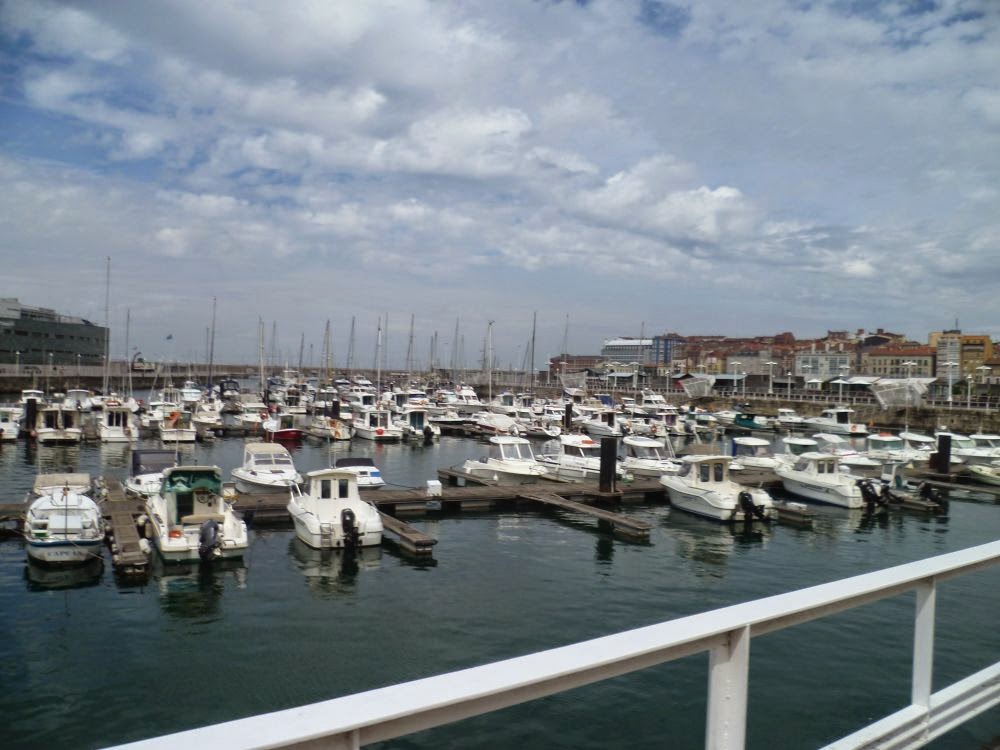
20 de Diciembre de 2014, posteando fotografías de Gijón, España, en un viaje anterior.

Gijón ha vivido de su puerto mucho tiempo, cuando fue importante durante la etapa industrial. Pero desde hace 40 años ha tenido que diversificar su economía.

The economy of Gijón was based upon its harbor long time when it was important during the industrial stage. But for 40 years the city has had to diversify its economy.